Thinking out loud
The design process didn't change. The tools did.
The design process didn't change. The tools did.
The design process didn't change. The tools did.
A personal take on AI in design · Apr 2026
I came in skeptical
I came in skeptical
When AI tools started flooding the design industry, my first reaction was to keep my distance. Not because I didn't believe in the technology, but because most of what I was seeing felt like noise — solutions looking for problems, or real problems being solved poorly. I kept working the way I always had.
What changed my mind wasn't a single tool or a single moment. It was a gradual realization, project by project, that certain parts of my process were starting to feel different — faster, less stuck, more fluid. And what struck me most was that the process itself hadn't changed at all. Discovery, ideation, prototyping, testing, delivery — the stages were exactly the same. I was deliberate about that. I didn't want the tools driving the outcomes; I wanted to stay in control of the quality. What AI changed was what each stage felt like, and how long it took.
Here's where I've actually found it useful.
When AI tools started flooding the design industry, my first reaction was to keep my distance. Not because I didn't believe in the technology, but because most of what I was seeing felt like noise — solutions looking for problems, or real problems being solved poorly. I kept working the way I always had.
What changed my mind wasn't a single tool or a single moment. It was a gradual realization, project by project, that certain parts of my process were starting to feel different — faster, less stuck, more fluid. And what struck me most was that the process itself hadn't changed at all. Discovery, ideation, prototyping, testing, delivery — the stages were exactly the same. I was deliberate about that. I didn't want the tools driving the outcomes; I wanted to stay in control of the quality. What AI changed was what each stage felt like, and how long it took.
Here's where I've actually found it useful.
It still starts with a pen and paper
It still starts with a pen and paper
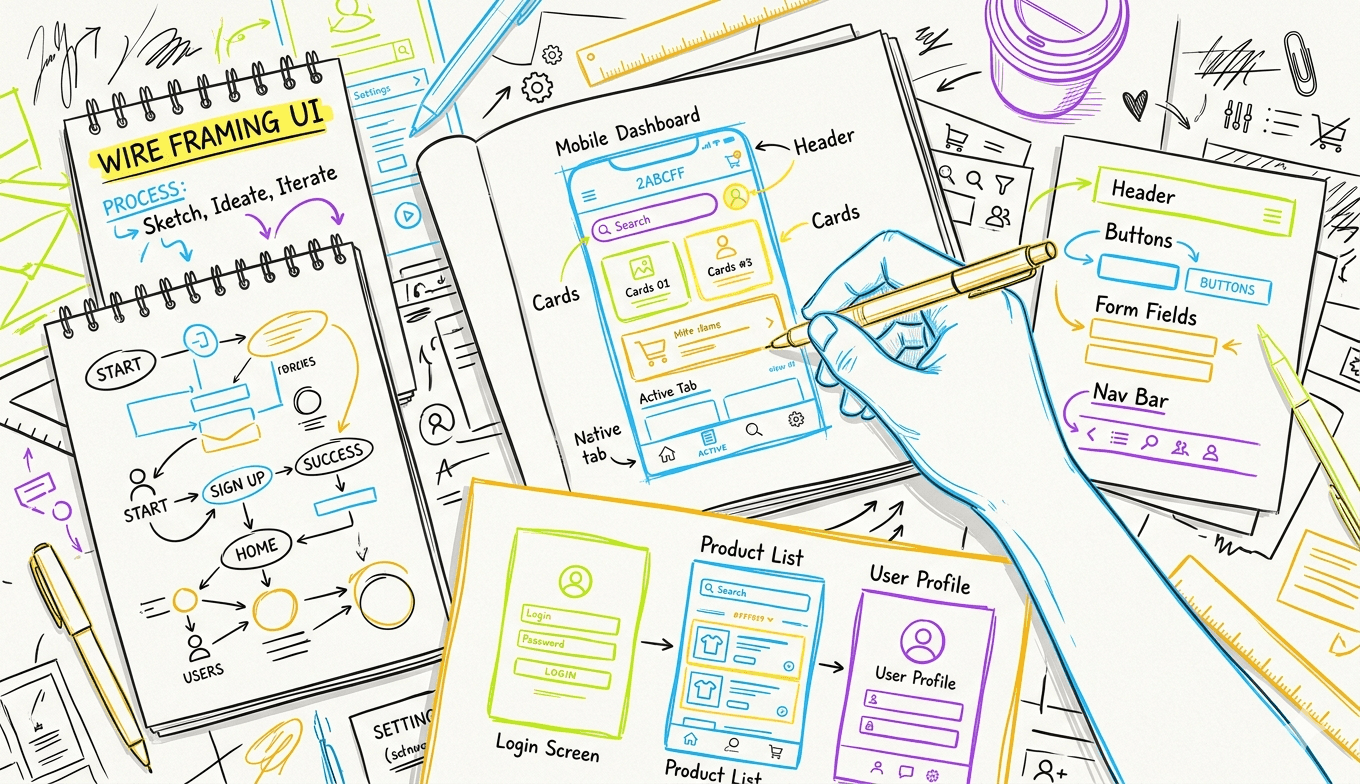
Before any tool, AI or otherwise, I still reach for a notebook. A few words, rough shapes, first instincts scribbled down before anything gets formalized. It's low-stakes and keeps the thinking honest. There's something about the physicality of it that no digital tool has replaced for me yet.
From there, when the strategic questions come up — what to prioritize, which feature to tackle, how to frame a problem for stakeholders — that's where Claude has become a genuine thinking partner. If I give it the right context: user research findings, business constraints, product goals, it helps me structure my reasoning and pressure-test my assumptions before I've committed to anything. I also use it to critique my own ideas early — feeding it a rough argument or a proposed direction and asking where the gaps are. It's like having a ruthless but patient editor who's read everything and has no stake in being right.
The quality of the output depends entirely on the quality of what you put in. That hasn't changed.
Before any tool, AI or otherwise, I still reach for a notebook. A few words, rough shapes, first instincts scribbled down before anything gets formalized. It's low-stakes and keeps the thinking honest. There's something about the physicality of it that no digital tool has replaced for me yet.
From there, when the strategic questions come up — what to prioritize, which feature to tackle, how to frame a problem for stakeholders — that's where Claude has become a genuine thinking partner. If I give it the right context: user research findings, business constraints, product goals, it helps me structure my reasoning and pressure-test my assumptions before I've committed to anything. I also use it to critique my own ideas early — feeding it a rough argument or a proposed direction and asking where the gaps are. It's like having a ruthless but patient editor who's read everything and has no stake in being right.
The quality of the output depends entirely on the quality of what you put in. That hasn't changed.
Generated with Nano Banana Pro
Generated with Nano Banana Pro
Breaking creative blocks
Breaking creative blocks
This is where I reach for ChatGPT most often. When I know the problem I'm trying to solve but can't find my way into a solution — when ideation feels like staring at a wall — ChatGPT is good at generating a wide range of starting points fast. Not polished ideas, but sparks. Directions I might not have considered, starting points I can react to, even if my reaction is "no, but that makes me think of something else entirely".
This is where I reach for ChatGPT most often. When I know the problem I'm trying to solve but can't find my way into a solution — when ideation feels like staring at a wall — ChatGPT is good at generating a wide range of starting points fast. Not polished ideas, but sparks. Directions I might not have considered, starting points I can react to, even if my reaction is "no, but that makes me think of something else entirely".
Five directions instead of two: rapid prototyping
Five directions instead of two: rapid prototyping
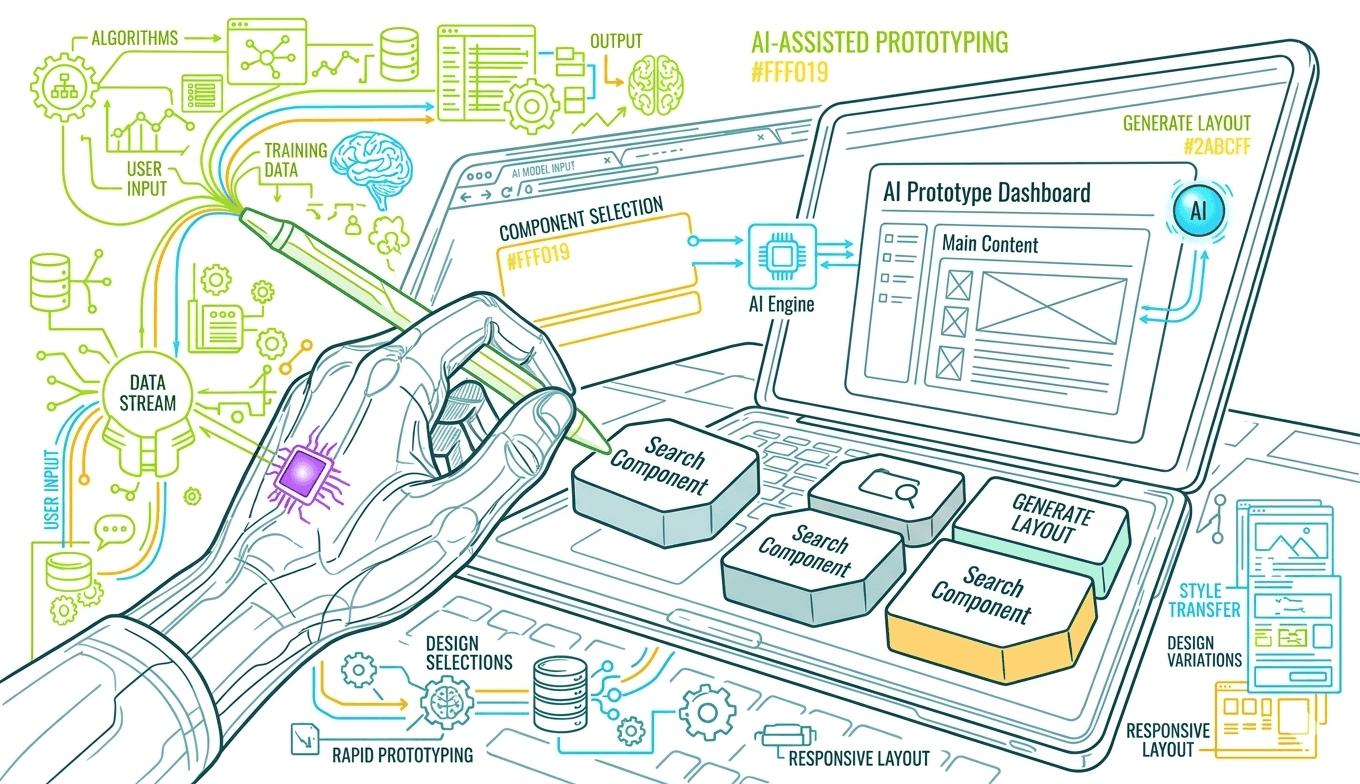
This is where AI has changed my day-to-day workflow most noticeably. When I need to put together multiple proposed solutions quickly — to test internally, show to a PM or PO, or even get in front of real users — I use Builder, V0, or Lovable.
In the time it used to take me to design one or two versions in Figma, I can now generate a wider range of options at whatever fidelity makes sense for the moment. That changes the conversation entirely. Instead of presenting one or two directions and hoping one lands, I can present five and let the team react. The design isn't done, but the thinking is visible faster, and that's what matters at this stage.
This is where AI has changed my day-to-day workflow most noticeably. When I need to put together multiple proposed solutions quickly — to test internally, show to a PM or PO, or even get in front of real users — I use Builder, V0, or Lovable.
In the time it used to take me to design one or two versions in Figma, I can now generate a wider range of options at whatever fidelity makes sense for the moment. That changes the conversation entirely. Instead of presenting one or two directions and hoping one lands, I can present five and let the team react. The design isn't done, but the thinking is visible faster, and that's what matters at this stage.
Generated with Nano Banana Pro
Generated with Nano Banana Pro
Designing for everyone
Designing for everyone
AI-assisted accessibility plugins have become a non-negotiable part of my process. Contrast checking, color blindness simulation, spacing and hierarchy audits — these used to require manual effort or a dedicated review. Now they're woven into the workflow. There's no excuse for shipping inaccessible design when the tools to catch it are this easy to use.
AI-assisted accessibility plugins have become a non-negotiable part of my process. Contrast checking, color blindness simulation, spacing and hierarchy audits — these used to require manual effort or a dedicated review. Now they're woven into the workflow. There's no excuse for shipping inaccessible design when the tools to catch it are this easy to use.
From first screen to final handoff
From first screen to final handoff
How the final design gets made depends entirely on the company, the team, and the stack. At Varsity Tutors, the workflow evolved as the company's stack changed: earlier projects were designed in Figma; later ones moved to Cursor, with the design system already integrated, and the UI part of my job became testing, refining, and making sure every detail worked as intended. Other contexts call for different approaches. The tool matters less than the quality of what comes out of it.
For copy — feature names, error messages, empty states, tooltips — I use Claude once it understands the product's tone of voice and has enough context about the user. It's not outsourcing the writing; it's having a shaped starting point that I then make my own.
For handoff documentation, AI has been a genuine time-saver. My documentation tends to be detailed — specs, interaction notes, edge cases, component annotations — and generating that with tools like Figma Make is significantly faster than writing it all from scratch. The engineer gets what they need. I spend the time I saved on the design itself and everything else that comes earlier.
How the final design gets made depends entirely on the company, the team, and the stack. At Varsity Tutors, the workflow evolved as the company's stack changed: earlier projects were designed in Figma; later ones moved to Cursor, with the design system already integrated, and the UI part of my job became testing, refining, and making sure every detail worked as intended. Other contexts call for different approaches. The tool matters less than the quality of what comes out of it.
For copy — feature names, error messages, empty states, tooltips — I use Claude once it understands the product's tone of voice and has enough context about the user. It's not outsourcing the writing; it's having a shaped starting point that I then make my own.
For handoff documentation, AI has been a genuine time-saver. My documentation tends to be detailed — specs, interaction notes, edge cases, component annotations — and generating that with tools like Figma Make is significantly faster than writing it all from scratch. The engineer gets what they need. I spend the time I saved on the design itself and everything else that comes earlier.
What no tool has replaced
What no tool has replaced
After all of this experimentation, two things remain completely irreplaceable:
Real users. AI can model behavior based on patterns, but it hasn't lived the problem. It doesn't know what it feels like to be a busy parent trying to understand how their child's tutoring session went, or a real estate agent managing dozens of leads from a mobile phone in the field. That understanding only comes from talking to real people, watching them use real products, and sitting with what you learn.
Human collaboration. A designer, product manager or engineer in a critique session will catch things no tool will, because they bring real context, genuine stakes, and accountability to the conversation. They care about the outcome in a way that an AI simply doesn't.
You cannot design well with just AI tools. The human factor isn't a nice-to-have — it's the whole point. AI is a remarkable accelerator. But acceleration in the wrong direction is still the wrong direction. The judgment about which direction to go — that's still ours, and I hope it stays that way.
After all of this experimentation, two things remain completely irreplaceable:
Real users. AI can model behavior based on patterns, but it hasn't lived the problem. It doesn't know what it feels like to be a busy parent trying to understand how their child's tutoring session went, or a real estate agent managing dozens of leads from a mobile phone in the field. That understanding only comes from talking to real people, watching them use real products, and sitting with what you learn.
Human collaboration. A designer, product manager or engineer in a critique session will catch things no tool will, because they bring real context, genuine stakes, and accountability to the conversation. They care about the outcome in a way that an AI simply doesn't.
You cannot design well with just AI tools. The human factor isn't a nice-to-have — it's the whole point. AI is a remarkable accelerator. But acceleration in the wrong direction is still the wrong direction. The judgment about which direction to go — that's still ours, and I hope it stays that way.
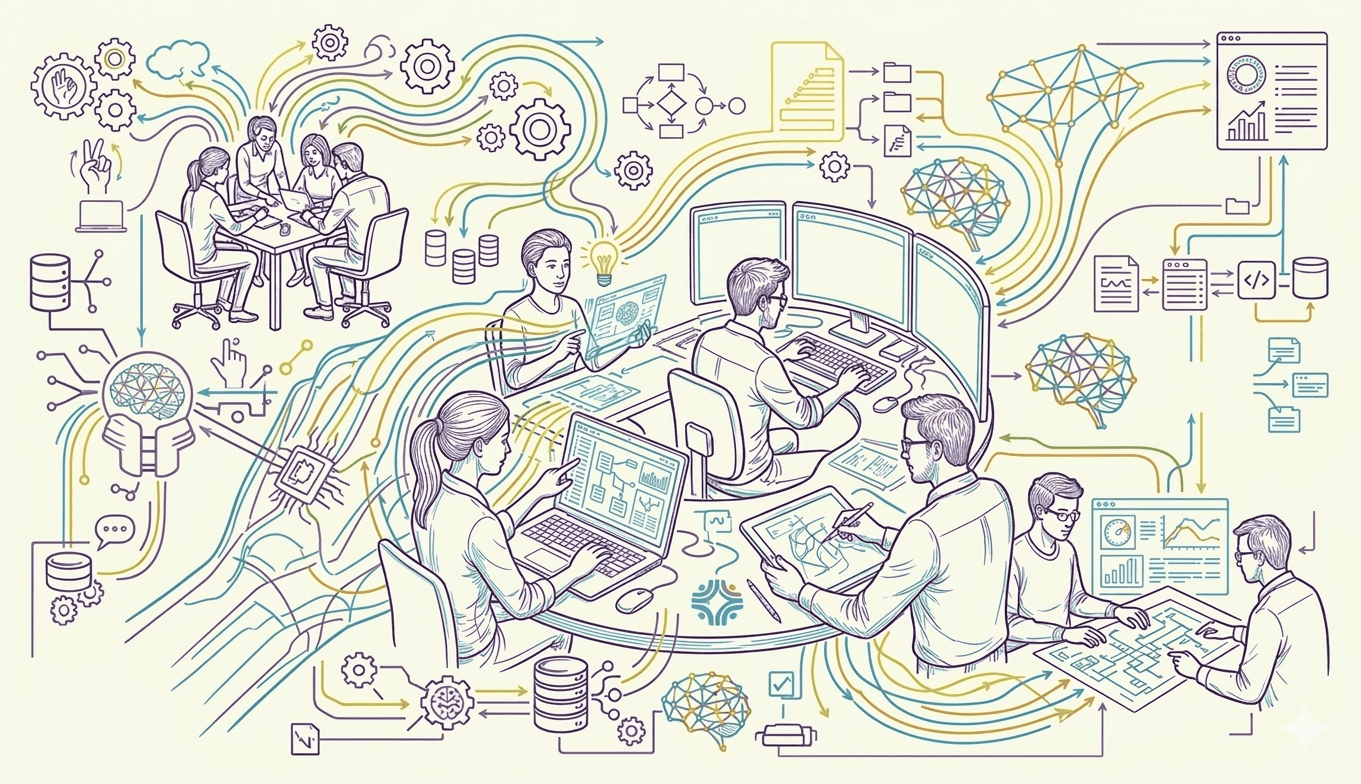
Generated with Nano Banana Pro
Generated with Nano Banana Pro
Still exploring
Still exploring
There are areas I haven't fully explored yet but am actively curious about: using AI to synthesise research data more efficiently, accelerating design system creation, and making competitive analysis faster and more comprehensive. I suspect they'll earn their own section here soon. The pace at which AI tools are evolving means this article will need updating before long, and I'm looking forward to that.
There are areas I haven't fully explored yet but am actively curious about: using AI to synthesise research data more efficiently, accelerating design system creation, and making competitive analysis faster and more comprehensive. I suspect they'll earn their own section here soon. The pace at which AI tools are evolving means this article will need updating before long, and I'm looking forward to that.